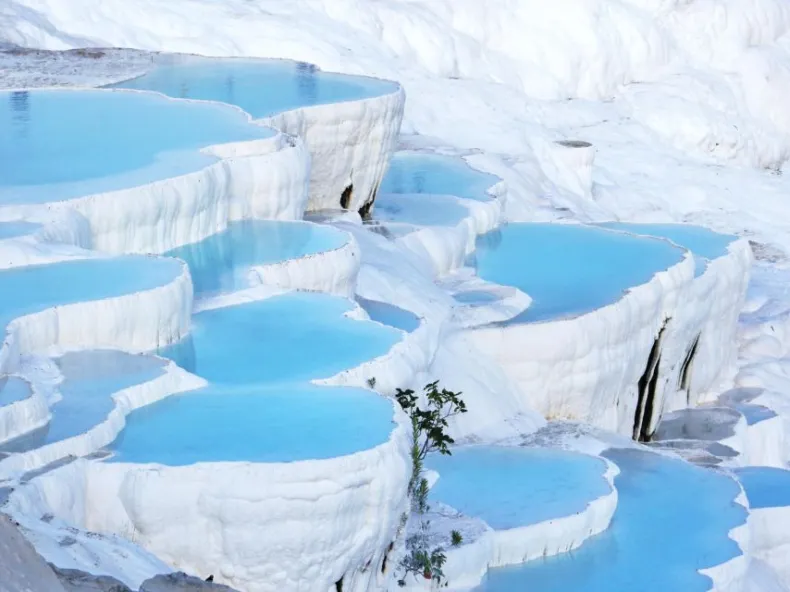
Karahayıt is the answer to a question most Pamukkale visitors never think to ask: what if the same thermal plumbing wore a different colour? Around five kilometres north of the white terraces, this spa village's springs emerge rich in iron — and instead of building white calcite, they stain their basins rust-red and orange. On our tour it is a seasonal-operational bonus stop: sometimes added, sometimes not, and never guaranteed. This guide explains what it is, what it is not, and how to think about it.
White hill, red water: the valley's two costumes
The famous travertine terraces of Pamukkale are the work of calcite — thermal water shedding pale minerals as it cools, layer upon layer, until a hillside gleams white. Karahayıt taps related underground heat with a different mineral recipe. Its water carries a strong load of iron, and iron paints in its own palette: deep reds, burnt oranges, ochres, layered over the spring mouths like slow-motion enamel.
The result is a striking natural colour lesson barely a valley apart: one source builds a white monument, the neighbour builds red sculpture. Photographers enjoy the pairing for exactly that reason — the same geological idea, printed in two different inks.
What Karahayıt actually is
Manage expectations here, because this matters: Karahayıt is not a second Pamukkale. There is no vast white hillside, no ancient city crowning it, no UNESCO listing of its own. It is a working Turkish spa village — hotels built on hot water, locals and visitors taking the waters, small shops selling thermal-town staples — with its famous red spring formations as the centrepiece.
That is precisely its charm. Pamukkale is a world monument that happens to be in Türkiye; Karahayıt is Türkiye going about its thermal traditions. The village has drawn bathers for generations who credit the mineral-heavy water with all manner of benefits — claims we pass along as tradition, not medical advice. A stop here adds texture to the day: after the grandeur of the terraces, a glimpse of the everyday spa culture the region grew around.
The village's rhythm deserves a paragraph of its own. Karahayıt's hotels are built around their thermal pools the way beach hotels are built around their sand, and the clientele has historically leaned local — Turkish families and older guests who come for unhurried soaking rather than sightseeing. Walking its main street, you see the region's bathing culture as a living habit instead of a heritage exhibit: this is what the tradition that built Hierapolis looks like when it never stopped. For travellers who collect that kind of texture, the stop can quietly outrank grander items on the day's list; for beach-focused visitors it is a pleasant leg-stretch with unusual colours. Both readings are correct, and either way it costs nothing extra — the stop, when it happens, sits inside the same flat price as everything else.
Will your tour stop there? The honest answer
Sometimes. The Pamukkale day tour's core programme is fixed — the terraces, Hierapolis with a licensed guide, lunch near the site, three meals in total — but the programme can flex with season and operating conditions, and a Karahayıt stop is one of the elements that may be added or removed operationally. The same applies to Lake Salda on certain routings. Neither is ever guaranteed, and we would rather tell you that plainly than sell you a promise the road cannot always keep.
The right way to hold it: if the stop happens, it is a bonus layered onto an already complete day; if it does not, you have missed a footnote, not a chapter. The €50 price, the included meals, the guide and the core visit are identical either way, and no part of the price depends on the bonus stop happening. Our Karahayıt page keeps the fuller picture of the village itself.
If the coach does pull in
A Karahayıt stop is short and easy: you walk to the red spring formations, watch mineral water do its slow painting, take the photographs nobody back home will believe are natural, and perhaps dip a hand where permitted — the water emerges notably warm. There is no barefoot terrace-walk ritual here and no swimming; think of it as a viewing stop with local flavour rather than a second bathing venue.
Small practical notes: the red-stained formations can be wet and smooth in places, so mind your step; and if the village's little shops are open, this is the most local browsing of the day. Keep a little cash handy — as everywhere on the trip, drinks and personal extras are your own.
The bottom line
Karahayıt is the kind of place tour brochures oversell and honest pages undersell; the truth sits comfortably between. Red springs five kilometres from white terraces are a genuine natural curiosity and a pleasant deepening of the day — when the routing allows. Book the Pamukkale tour for the terraces, Hierapolis and the three-meal day it always delivers; treat Karahayıt as the region's occasional encore. For how the whole day fits together, stop by the ultimate guide before you go.