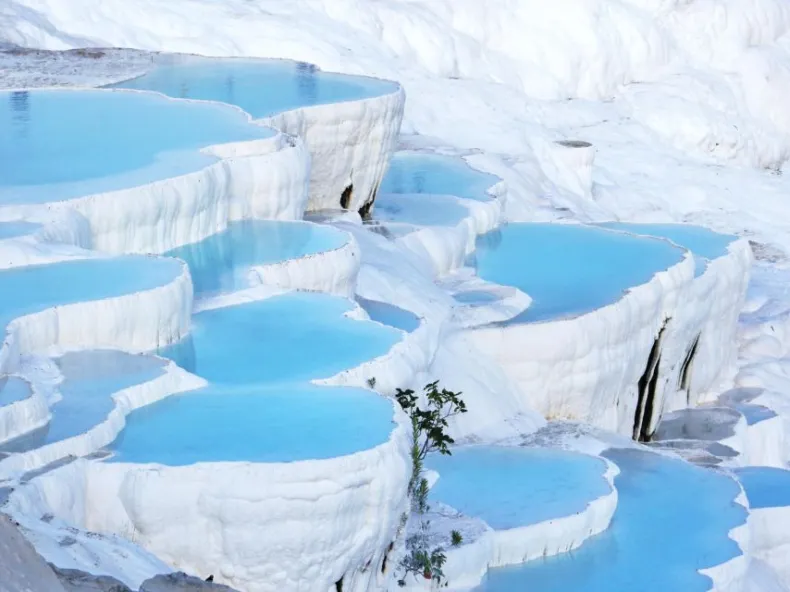
You walk barefoot at Pamukkale because shoes damage the terraces. The white surface is calcite — a soft mineral laid down, layer by thin layer, by thermal spring water — and shoe soles grind grit into it, scuff its surface and track in dirt that dulls the white. Bare feet are gentler on the stone, and the site enforces the rule in the designated open section: everyone, from toddlers to tour guides, carries their shoes. It is one of the few famous rules in world tourism that visitors end up loving, because it turns a viewpoint into an experience.
The rule, and the reason behind it
Pamukkale means "cotton castle" in Turkish, and the name is a maintenance instruction as much as a description. The hillside is built from travertine — calcite deposited over millennia as mineral-rich thermal water flowed down the slope and left its load behind, thin film after thin film. That process is still running today, which is the point most visitors miss: the terraces are not a finished monument but a live geological workshop, still being painted white by the same springs. The travertines page tells that story properly.
Fresh calcite is soft. Hard rubber soles, hiking treads packed with grit, heels — all of them work like sandpaper on it, and the dirt they carry stains the very whiteness everyone came to photograph. So the site draws a simple line: in the open walking section, shoes come off. The rule protects the calcite, and it is why the section that receives a river of visitors can stay white at all. Pamukkale and the ancient city above it have formed a single UNESCO World Heritage Site since 1988, and the barefoot rule is the everyday, visitor-level end of that protection.
The same logic draws a second line that trips up first-time visitors: on the terraces you wade, you do not swim. The open-section pools are shallow — ankle to knee — and they are crossed slowly on foot, not swum like a lido. Actual swimming belongs to the Cleopatra Antique Pool above, with its own ticket bought on site. It is also why the terraces stay pleasant to walk at all: a surface maintained by flowing spring water and bare soles wears entirely differently from one ground down by boots.
What calcite actually feels like underfoot
The surprise is how good it feels. From photographs people expect either glass-smooth marble or sharp coral; calcite is neither. The walked section is ridged and rippled — imagine firm wet sand that set solid mid-wave — and those little corrugations give your soles a constant, reassuring grip. Where the thermal water runs over it, the stone is silky rather than slimy; where it stands in pools, you wade through warm, shallow water with the texture massaging your arches at every step.
People with soft office feet manage it fine. The gradient is gentle, the pace is a stroll, and the water is doing half the work of making it pleasant. Children treat the whole stretch as a sanctioned adventure — see our full guide to the day for how the barefoot section fits into the wider visit. The only technique worth knowing: take shorter steps on the wet flowing stretches, and stand still when you want to look around rather than walking while gawking.
The practical side: carrying your shoes
The rule creates one small logistics problem — your shoes have to travel with you — and one small purchase solves it. Bring a drawstring bag, tote or any light sack per person; shoes go in at the top of the open section and come back out at the far end. Hands stay free for cameras and children, which matters more than it sounds on the wet stretches. Slip-on footwear makes both transitions instant, which is exactly why our packing advice keeps repeating the phrase "shoe bag".
Timing helps too. Give the barefoot stretch more time than the photographs suggest it needs — the pleasure is in the slow crossing, not the sprint — and if a knot of people forms around one famous ledge, drift a few terraces sideways: the hillside is wide, and the calcite is just as white where nobody is standing.
Two small courtesies keep the system working. Stay inside the open section — the roped-off terraces are resting, regrowing their white skin undisturbed — and resist the urge to test the closed pools, however photogenic. The rule only protects the stone if everyone follows it, and wardens do enforce it.
The rule that became the attraction
Here is the quiet truth about the barefoot rule: it is the best thing that ever happened to the visit. Nearly every famous landscape on Earth is experienced through glass, from a walkway, behind a railing. Pamukkale you feel — warm water at your ankles, ridged living stone under your soles, the same springs that built the hillside still washing over your feet. Conservation and experience, for once, pull in the same direction. To feel it for yourself, reserve the day tour online for free — pay on the day, shoes optional but a bag for them essential.