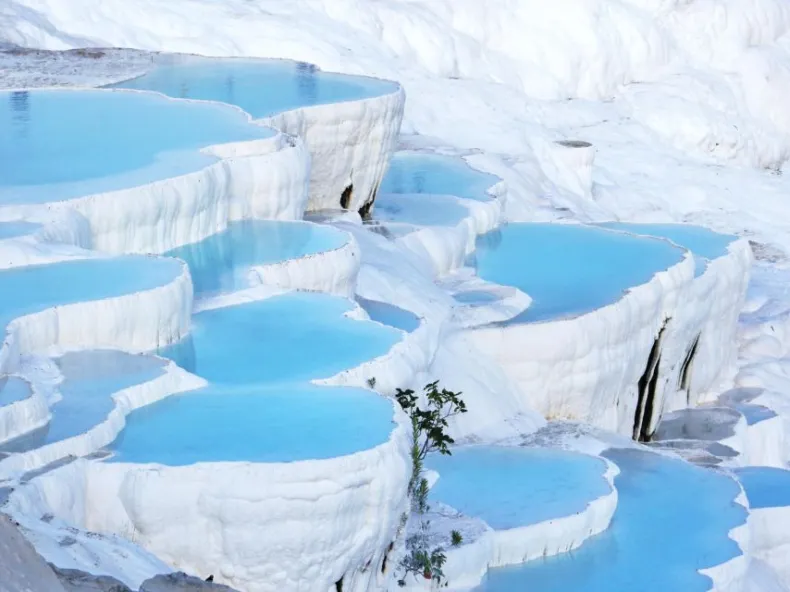
Hierapolis exists for one reason, and it is the same reason you are planning a visit: warm water coming out of a hillside. More than two thousand years ago, people decided that springs this generous deserved a city, and the result — built up under Hellenistic rulers, expanded magnificently under Rome — is the great ruin field that crowns the white terraces of Pamukkale today. Here is its story in the time it takes to drink a coffee.
A city built on warm water
Most ancient cities grew where trade routes crossed or harbours sheltered. Hierapolis grew where the ground steamed. The thermal springs that paint the travertine terraces white were the city's founding industry: people came to bathe in them, drink them and credit them with cures, and the town that served those visitors grew rich doing it.
That makes Hierapolis one of antiquity's clearest examples of a spa city — a place whose streets, temples and grand public buildings were all, in a sense, downstream of a spring. The name itself is usually read as "sacred city", and the sanctity and the water were never separate: healing, worship and civic pride shared the same source.
The Roman centuries: healing as an industry
Under Roman rule the city hit its stride. The empire's wealthy travelled for their health much as we travel for sunshine, and Hierapolis offered the full package: baths fed by the springs, temples for the grateful, colonnaded streets for the evening stroll. Frontinus Street — the long, monumentally gated main axis you still walk today — shows the scale of the operation. This was not a village with a nice spring; it was a destination, engineered to impress arrivals from the moment they passed the gates.
The showpiece is the theatre, carved into the hillside above the city with the plain below unrolling behind the stage. It ranks among the most impressively preserved Roman theatres anywhere, and standing at its top tier remains the best single spot to grasp what this city was: wealthy, confident and built to be looked at.
Give your feet fair warning: Hierapolis is a real city in area, and seeing its highlights means genuine walking on ancient surfaces — worn paving, packed earth, low steps. Comfortable closed shoes, a hat and water turn the march into a stroll. The reward is that the site never feels like a single roped-off monument; it feels like wandering an abandoned town where every corner still argues its former importance. Photographers should save some patience for the monumental gates: shot along the street's axis, they still frame arrivals exactly the way their builders intended, two thousand years of traffic later.
The necropolis: the city's most honest monument
Walk out along the old roads and you reach the necropolis — one of the best-preserved ancient cemeteries in Anatolia, a vast field of sarcophagi, house tombs and burial mounds stretching away from the city. Its size tells a story the guidebooks sometimes soften: a healing city attracts the seriously ill, and not everyone who came to the springs left again.
There is nothing morbid in visiting it today. The necropolis is where Hierapolis feels most human — thousands of individual decisions about how to be remembered, lined up along the roads where every traveller would pass. If the theatre shows the city's wealth, the tombs show its clientele.
The Christian layer and the long afterlife
Hierapolis did not end with Rome. As the empire Christianised, so did the city, and church remains among the ruins mark the shift — the healing town around a pagan sanctuary becoming a centre of the new faith. This early-Christian layer is the last great chapter of the living city; in the centuries that followed, earthquakes, decline and abandonment slowly handed the streets over to the calcite and the wind.
What remained was extraordinary enough that in 1988 UNESCO inscribed Hierapolis-Pamukkale as a single World Heritage Site — a mixed property, honoured for nature and culture at once. The terraces and the city above them are not two attractions sharing a car park; they are one place, made by the same water, and the listing simply made that official.
Seeing it with your own eyes
The practical part is pleasingly simple. Every Pamukkale day tour from the Antalya coast pairs the terraces with a guided walk through Hierapolis — theatre, gates, main street and necropolis — with a licensed guide turning the stones back into a city as you go. The €50 seat covers transport, guide, insurance and three meals; entrance tickets are paid at the official gate price, and the optional Cleopatra Pool, where you can swim above submerged ancient columns, has its own ticket on site.
Two thousand years ago, people crossed these mountains because they believed warm water could fix them. You will cross the same mountains in an air-conditioned coach with breakfast served en route — and when you stand in the theatre looking down over the white hill, you will understand exactly why they came. For the full picture of how the day fits together, the ultimate guide walks through every chapter.