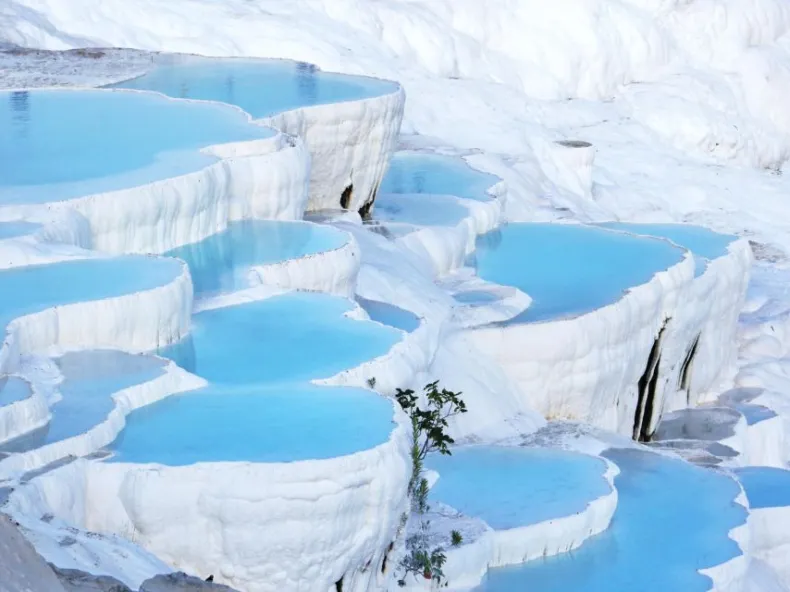
The white terraces get the photographs, but the plateau above them holds the reason this hillside mattered to the ancient world: a complete Greco-Roman city. Hierapolis was founded under the Hellenistic kings of Pergamon and grew rich under Rome as a spa in the fullest sense of the word — people crossed seas and mountains to bathe in its hot springs, hoping the water would manage what their physicians could not. City and terraces were listed together by UNESCO in 1988 as Hierapolis-Pamukkale, one of the organisation's rare mixed World Heritage Sites.
Enough survives to fill the best part of a day: a theatre cut into the hillside, a dead-straight colonnaded street between monumental gates, the foundations of temples and early churches, and an ancient cemetery that spreads along the northern road like a suburb. On the full-day tour from the Antalya coast you walk it with a licensed guide — the flat €50 covers the day and its three meals, while entrance tickets are paid at the official gates.
A City That Ran on Hot Water
Most ancient cities grew where trade routes crossed or where harbours sheltered ships. Hierapolis grew around a medical resource. The springs that rise here are the same ones that built the terraces below, and under Hellenistic and then Roman rule the city turned them into an industry: baths and pools to soak in, temples to give thanks in, physicians, priests and innkeepers to look after the constant stream of arrivals. The sick, the ageing and the simply curious came from across the Mediterranean, and the city arranged itself entirely around their hopes.
That is worth keeping in mind as you walk the ruins. Hierapolis was never a fortress that happened to have baths — hot water was its founding idea, its economy and its religion all at once.
What Survives on the Plateau
The single most impressive monument is the Roman theatre, carved into the slope above the city and preserved to a degree that earns it a page of its own. Below it, the ancient plan is still easy to read: the long straight main street named after Frontinus, the monumental gates with their round towers, the agora, the temple of Apollo, bath buildings, and the walls of churches from the city's later, Christian centuries.
Then there is the edge of town. Past the northern gate the road runs into the necropolis — one of the best-preserved ancient cemeteries in Anatolia, and the strangely logical companion of a healing city: not everyone who came for a cure went home again.
How the Guided Visit Works
The mechanics are simple. The coach parks by the entrance, tickets are bought at the official gate — the tariff is set by the site administration and moves with the seasons, which is exactly why we keep it out of our flat price — and the licensed guide then leads the group through the highlights on foot, with the stories that turn stone foundations back into a working city.
After the guided loop comes free time: wade the travertine pools barefoot, take the optional swim among the sunken columns of the Cleopatra Antique Pool (its own ticket, paid on site), or browse the museum. Before the group scatters, the guide fixes a clear meeting point — so your attention stays on the ruins, not on keeping the coach in sight.
Hierapolis on the €50 Day Tour
Hierapolis is the historical heart of the Pamukkale tour from Antalya: €50 per person whichever of the 30 coastal pickup areas you start from, with breakfast served on the morning drive, lunch near the site and dinner on the way home. Entrance tickets stay separate on purpose — you pay the real official price at the gate instead of a padded estimate buried in ours, and this page explains how that works. Reserving online costs nothing; payment waits until the day of the tour.