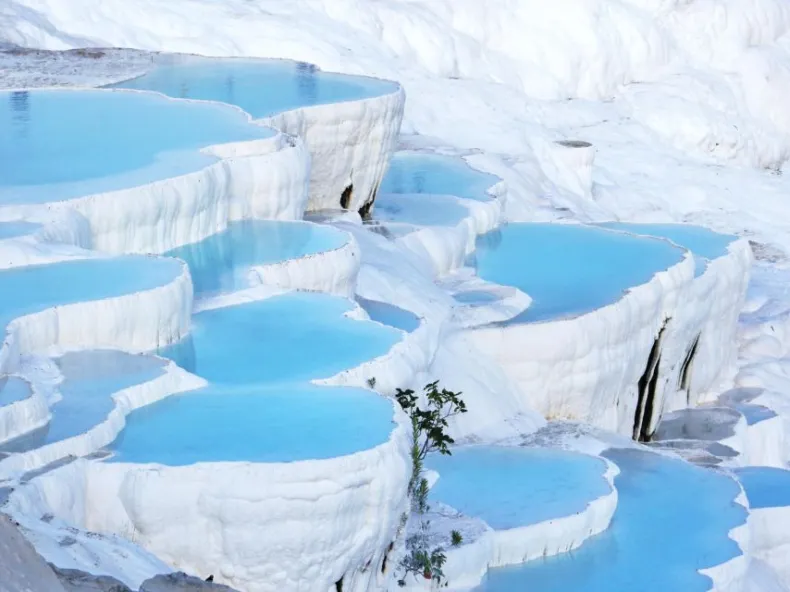
Honest answer: parts of Pamukkale are slippery, and most of it is not. Wet calcite is slick where the thermal water actively flows — in the channels and on smooth washed-over stretches — while the ridged, rippled stone of the walking route grips bare feet surprisingly well. The barefoot rule works in your favour here: soles read the surface far better than wet shoe rubber ever could. Add uneven ancient paving in Hierapolis and strong sun as the day's quieter hazard, and you have the honest safety picture — very manageable for most visitors, worth real thought for a few.
Where it is slippery — and where it is not
The travertine terraces are not one surface but several. The walked section is corrugated by nature: ripples, ridges and little rims of calcite that give the soles of your feet constant purchase, plus warm shallow water flowing over them. On these stretches, most people are steadier than they expected to be — the texture is closer to firm rippled sand than to wet tile.
The caution zones are the flow channels: where the thermal water runs fast and the stone has been polished smooth by the current, the surface turns genuinely slick. You can read these stretches by eye — smoother, shinier stone with moving water — and the technique is the one your grandmother taught you: shorter steps, slightly bent knees, stand still to look around instead of walking while staring at the view. Wardens keep visitors to the open route on the terraces precisely because it is the sensible line through the hillside.
Why bare feet are secretly your friend
First-timers assume the barefoot rule adds risk. In practice it removes it. Bare soles flex, spread and feel the surface, adjusting grip step by step in a way no wet flip-flop sole can; the rule exists to protect the soft calcite, but its side effect is that every visitor crosses the wet stretches with their best available equipment. Feet also dry fast, and the walking pace on the terraces is a stroll rather than a hike — this is not scrambling terrain.
If your balance is average or better, the barefoot stretch is comfortably within reach; children handle it happily with a hand held on the wet parts. Keep one hand free rather than full of gear — a small bag for shoes and camera does more for your stability than any specialist footwear you cannot wear anyway.
Hierapolis: old stones and honest sun
Above the terraces, the risk profile changes character. Hierapolis is an authentic Greco-Roman city — which means original paving polished by two thousand years of feet, gravel paths, and stretches of uneven ground around the theatre and necropolis. Nothing about it is difficult in hiking terms; everything about it rewards proper shoes rather than the flip-flops you wore for the terraces, which is why the shoe bag doubles as a shoe swap.
The quieter hazard on the whole hilltop is the sun. The site is open and shade is scarce, and white calcite reflects light upward, doubling the dose. A hat, sunglasses, sunscreen reapplied after the wading, and a drink in hand solve what is, statistically, the most common discomfort of the day — nothing dramatic, just physics that punishes the unprepared. Our full guide folds these tactics into the whole day's plan.
The seasons shuffle the same deck rather than dealing a new one. In summer the sun climbs the ranking and the glare peaks around the middle of the day — exactly when the format offers a sit-down lunch and the option of a swim. In the cooler months the sun relaxes but the layer matters: the thermal water keeps bare feet comfortable in the pools, while the exposed hilltop asks for something windproof. The slick stretches, for their part, are a constant — the thermal water flows all year, so the short-step technique never goes out of season.
Who should think twice — and what the tour carries for you
Most visitors, from toddlers wading with parents to grandparents pacing themselves through the ruins, manage Pamukkale comfortably at their own speed — the day is built as a stroll, not a march, and you can always shorten the barefoot stretch or skip the wading entirely and enjoy the terraces from the walking route. The honest exceptions: severe mobility issues, recent leg or hip injuries, and anyone for whom uneven ground or standing heat is a genuine medical matter rather than a nuisance. For those travellers, the barefoot slope and the old stones may be more risk than reward, and it is fairer to say so than to sell the ticket.
What the guided day contributes to the safety picture: travel insurance is included for every guest, a licensed guide stays with the group and knows the route's character stretch by stretch, and the coach day removes the single biggest real risk of any independent visit — six to ten hours of self-driven mountain road. See exactly what is included, and when you are ready, reserve your day online for free and pay on the day. Come with sensible feet and a hat, and Pamukkale repays you with nothing more dangerous than a full camera.