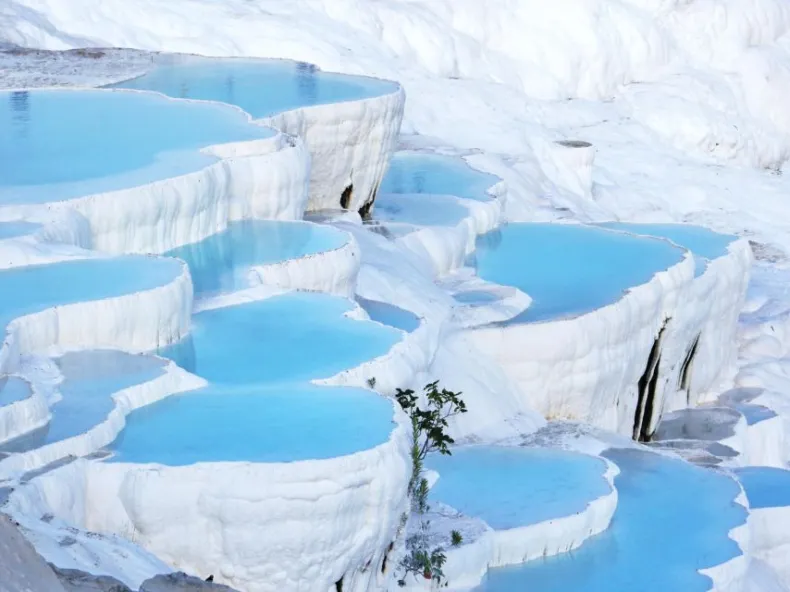
Let us say it plainly, because plenty of tour pages will not: Pamukkale is one of the most famous sights in Türkiye, and famous sights draw people. On high-season middays the most photographed stretch of the terraces is genuinely busy. But "busy" is not the whole story — crowding here is concentrated in a narrow window of time and a surprisingly small patch of ground, and once you understand both, finding space becomes almost easy.
The honest picture
Crowds at Pamukkale follow two rhythms. The first is the year: the school-holiday summer peak is the fullest the site gets, the shoulder seasons are noticeably calmer, and deep winter can feel close to private. The second is the day: middays in high season are the crest of the wave, when day-trippers from every coast and city overlap at the same pools, while mornings and late afternoons breathe more easily.
Where people stand matters just as much as when. The bulk of visitors gather along the most famous section of the travertine terraces — the photogenic pools everyone has seen online — and around the main paths near them. Step beyond that zone and the density drops away faster than first-time visitors ever expect.
The calendar lever
If your dates are flexible, the calendar is the most powerful crowd tool you have. Autumn keeps daily departures and generous light while the summer surge fades — the case is laid out in our guide to Pamukkale in October and November. Spring behaves similarly from the other side of summer. And winter is the connoisseur's answer: cool air, steaming pools and the ancient city nearly to yourself, with the tour running Monday to Saturday through the deep season.
If your dates are fixed in July or August, do not despair — that is most people's reality, and the day still works. It simply asks you to use the other two levers: geography and attitude. For the full seasonal trade-offs, the best time to visit Pamukkale guide compares all four seasons without wishful thinking.
One framing fact helps set expectations: the site itself is open from early morning to evening, with hours changing seasonally — the official pages of the culture ministry carry the current schedule. A guided day arrives inside that window with the timing already solved, which is one less variable for you to manage; independent visitors juggling opening hours, parking and light run the same puzzle alone. Either way, the crowd curve is the same hill — the trick is standing on the parts of it this article keeps pointing at.
The geography lever: walk further
Here is the single most useful sentence in this article: the terraces are much bigger than the famous photograph. The white hillside runs on well past the busiest pools, and the crowd thins with every step along the ridge. Walk a few minutes further than the densest cluster and you will find pools with room to stand still, edges with nobody framing the same shot, and angles across the white slope that most visitors never see because they never left the first hundred metres of view.
Above the terraces, the escape is even easier. Hierapolis is vast — a whole Greco-Roman spa city, from the hillside theatre to a necropolis that ranks among the best-preserved ancient cemeteries in Anatolia. It absorbs visitors the way a city absorbs pedestrians. Even on the fullest afternoons, the outer streets and the long rows of tombs are quiet enough to hear the wind.
Does a coach tour fight the crowds or join them?
A fair question. The honest answer: a guided day neither creates the midday crest nor magically avoids it — but it changes how you experience it. Your guide knows which direction to walk the site, keeps the group moving against the natural bottlenecks, and hands you the context that turns a busy monument into a legible one. You also arrive rested rather than frazzled, because the driving, parking and meal logistics were never your problem.
And the parts of the day that frame the visit — breakfast rolling through morning countryside, lunch near the site, dinner on the homeward drive — are yours regardless of how many people the terraces drew that day. Crowds can share the view; they cannot touch the day's structure.
A realist's checklist
Pick the calmest season your holiday allows, and if that is high summer, accept the midday crest as the price of the year's most dramatic light. On the hill, walk further along the ridge than the first cluster of tripods. Give Hierapolis real time instead of treating it as the terrace's lobby. And remember that the €50 seat — hotel pickup, licensed guide, insurance, three meals — costs the same on the emptiest February Tuesday as on the fullest August afternoon, with infants aged 0–3 free. Reserve online for free, pay on the day, and cancel free up to 24 hours before if your plans change. The white hill has been drawing admirers for more than two thousand years; with a little strategy, it will still find room for you.