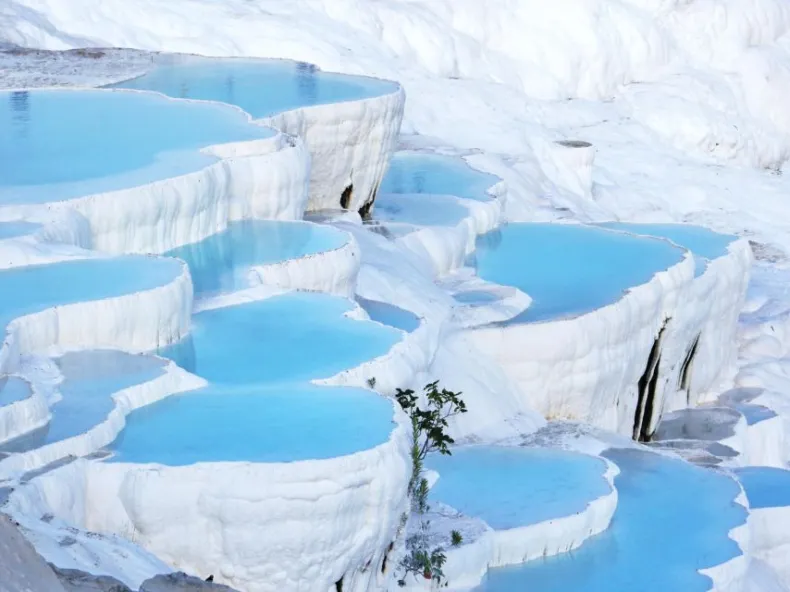
Spring gives Pamukkale something no other season can: colour contrast. For a few months the plateau around the white hill turns properly green — fields, poplars, fresh grass along the ancient streets of Hierapolis — and the terraces stop being a white monument on brown land and become a white wave rising out of a green one. Add comfortable walking air and skies that photographers plan trips around, and spring makes a very strong claim to be the connoisseur's pick.
The colour combination spring owns
Most photographs of the travertine terraces play white against blue: hill against sky. Spring adds the third colour. Rain through the cooler months wakes the plateau up, and for a while the approach to the site runs through a genuinely green landscape — a frame the postcards rarely show you because most visitors come after summer has toasted it.
The greenery changes the ancient city too. Hierapolis in spring is grass between tumbled column drums, wildflowers along the necropolis paths, and the hillside theatre looking out over a valley in fresh leaf. It is the same archaeology with better staging.
Walking weather at its kindest
A Pamukkale day involves more walking than people expect: the open section of the terraces climbed barefoot, then the long streets, gates and theatre of a Greco-Roman spa city that has been growing for more than two thousand years. Spring is when all of that is at its most comfortable — warm enough for the wading pools to feel wonderful, cool enough that nobody is rationing their energy by midday.
The barefoot part deserves its own note. The thermal water emerges warm all year, and in spring the contrast is gentle rather than dramatic: mild air, warm shallow water, no summer glare hammering off the calcite. Families with children who want to splash and wander at their own pace tend to remember spring visits as the easy ones. As always, the terraces are for wading only — swimming belongs to the optional Cleopatra Pool and its own on-site ticket.
Photographers' skies
Spring weather on an inland plateau moves. Clouds build, drift and break; light comes and goes in minutes rather than settling into the fixed glare of high summer. For photography that is not a nuisance but the whole gift: texture in the sky above the white hill, shifting patches of brightness on the terraces, and — after a passing shower — that rinsed clarity that makes every colour deeper.
The practical consequence is simply to pack one thin extra layer and not to fear a mixed forecast. A spring day that starts grey over the coast routinely turns spectacular over Denizli province, and the site is dramatic in changing light in a way a flawless August sky never quite matches.
The practical spring picture
Spring is when the schedule opens up: daily departures resume in March after the Monday-to-Saturday winter rhythm, and they run daily all the way to November. Everything else stays constant year-round — early-morning hotel pickup with the exact time confirmed at booking, breakfast on the drive, licensed guide, lunch near the site, dinner on the return, all inside the flat €50 per person. Infants aged 0–3 join free, and entrance tickets remain separate at the official gate price.
Booking works the way it always does: reserve your seat online for free and pay on the day, with free cancellation up to 24 hours before departure. Spring demand is gentler than the summer peak, which makes it a good season for choosing your preferred date rather than taking what is left.
The same programme note applies in spring as all year: the core day — terraces, guided Hierapolis, the three meals — is fixed, while bonus stops such as Karahayıt or Lake Salda may be added or removed with the season's operating conditions, never promised. Spring's flexible weather makes this the season where routings breathe the most. And spare a thought for the drive: the Taurus crossing that looks toasted in August is at its greenest now, valleys in leaf and streams running high, so the window seat earns its keep long before the white hill appears. More than a few travellers call the spring approach the prettiest overland stretch of their whole holiday. If you are torn between a spring and a summer date, remember that the wading is equally warm in both — it is the air around the water that changes.
Spring against the other seasons
Every season at Pamukkale has an honest sales pitch: summer brings heat theatre and deep blue skies, autumn balance, winter steam and solitude. Spring's pitch is comfort plus colour — the season when the walking is easiest, the plateau is greenest and the light is liveliest. If you are weighing all four options properly, our guide to the best time to visit Pamukkale puts them side by side without favouritism.
But if your holiday lands between March and May, there is no decision to agonise over. You have drawn the season when Hierapolis wears wildflowers, the terraces rise out of green fields, and the whole long day — coach, meals, barefoot water, ancient stone — unfolds in the year's most forgiving air.