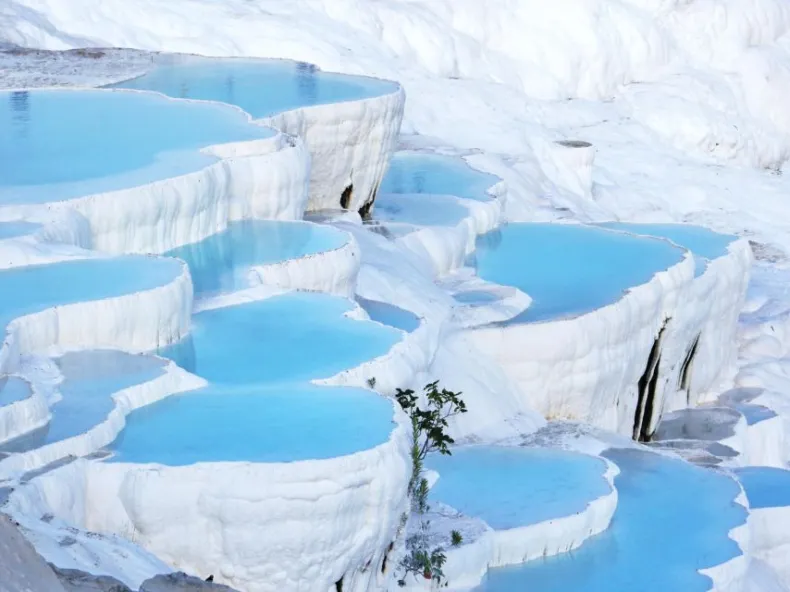
Winter is the season Pamukkale keeps for travellers who like their wonders quiet. The crowds thin out, the light turns low and silvery, and the site's oldest trick becomes visible: warm thermal water meeting cold air and rising as steam off the white terraces. If you are on the Antalya coast between December and February, the trip is not a compromise — it is a different, arguably more atmospheric version of the same day.
The photograph winter owns
Every season has its signature image. Summer has cobalt skies over blazing white; winter has steam. The spring water emerges warm all year round, so when the plateau air cools, the terraces smoke gently like a heated pool at dawn. White hill, pale sky, drifting vapour — it is the shot photographers cross continents for, and in winter you simply walk into it.
The low winter sun helps too. Instead of the flat overhead glare of high season, light comes in at an angle for much of the day, giving the terrace rims shadows and texture. If your favourite travel photos lean moody rather than postcard-bright, this is your season.
Space is the real luxury
The honest reason winter converts people is simpler: room. The open section of the terraces feels unhurried, and you can stand still — feet in warm water, breath visible in the cool air — without negotiating for position. Nobody waits behind you while you take one more picture.
The ancient city above the terraces gains even more. Hierapolis is vast, and in the quiet months its long colonnaded street and hillside theatre return to something like their old solemnity. Wandering a Greco-Roman spa city — a UNESCO World Heritage Site with the terraces since 1988 — with only a scattering of other visitors is an experience high summer simply cannot sell you.
What actually changes in winter
Two practical things. First, the schedule: the tour runs Monday to Saturday from December to February, instead of the daily rhythm it keeps from March to November. Sundays pause for the winter, so check the booking calendar a day or two more flexibly than you would in summer.
Second, the packing list flips. You want proper layers — a warm jacket, something windproof, comfortable closed shoes for the ruins — plus the strange, wonderful winter specific: bare feet. Shoes still come off on the designated open section, and the contrast is the whole point. The thermal water stays warm while the air stays crisp, and wading through a steaming pool in January is a story you will tell for years. Bring a small towel for your feet and thick socks for afterwards; your future self will be grateful.
Why the meals matter more
In July, the three included meals are a convenience. In January, they are the architecture of the day. Breakfast arrives during the dark early drive and doubles as the moment the trip starts to feel real. A hot lunch near the site lands exactly when the morning's cool air has earned it. And dinner on the return leg turns the long evening drive into the cosy final chapter rather than a slog — you watch the dark mountains slide past with a warm meal in front of you.
It is worth saying plainly: the winter price is the same flat €50 per person that applies all year, with hotel pickup, the licensed guide, insurance and all three meals included, and infants aged 0–3 free. Entrance tickets stay separate at the official gate price, in winter as in every season. There is no low-season surcharge and no stripped-down winter version of the programme.
Who should choose winter — and who should not
Choose winter if you value calm over warmth: photographers, couples, repeat visitors who saw the summer version and want the moodier one, and anyone staying on the coast off-season anyway. Skip it if your heart is set on long bright evenings and swimming weather at the optional Cleopatra Pool — the pool stays warm, but the walk back to the changing room belongs to January, not July. For the full season-by-season picture, our guide to the best time to visit Pamukkale lays the year out honestly, and if high summer is what your holiday offers, the summer heat playbook shows how to do that version well.
One more winter honesty: weather on an inland plateau is less predictable than on the coast, so pack for cool and hope for bright. The white hill under a clear winter sky is dazzling; the same hill wrapped in drifting cloud is mysterious. There is no losing draw.
Booking the quiet season
Winter seats are the easiest of the year to plan: reserve online for free, pay on the day of the tour, and cancel free of charge up to 24 hours before departure if the forecast changes your mind. Pickup is from your hotel door in the early morning, with the exact time confirmed with your booking. The quiet season asks only one thing of you — a warm coat — and repays it with the terraces at their most personal.