Pamukkale Tour from Göynük
Ask people why they chose Göynük over the busier resorts and most of them point at the mountains: the canyon is here. This stretch of the Kemer coast doubles as an outdoor playground — a beach town with a gorge and a nature park at its back door, where river shoes get packed as readily as flip-flops. If that describes your suitcase, Pamukkale deserves a day of your week, because Turkey's most famous natural wonder is, underneath the postcards, a piece of living geology you explore on foot. The white terraces lie roughly 275 km from Göynük; allow 3.5–4 hours of road per direction, with pickup from your hotel entrance early in the morning — the hour itself is fixed when your booking is confirmed — and breakfast served while the coach climbs the Taurus passes.
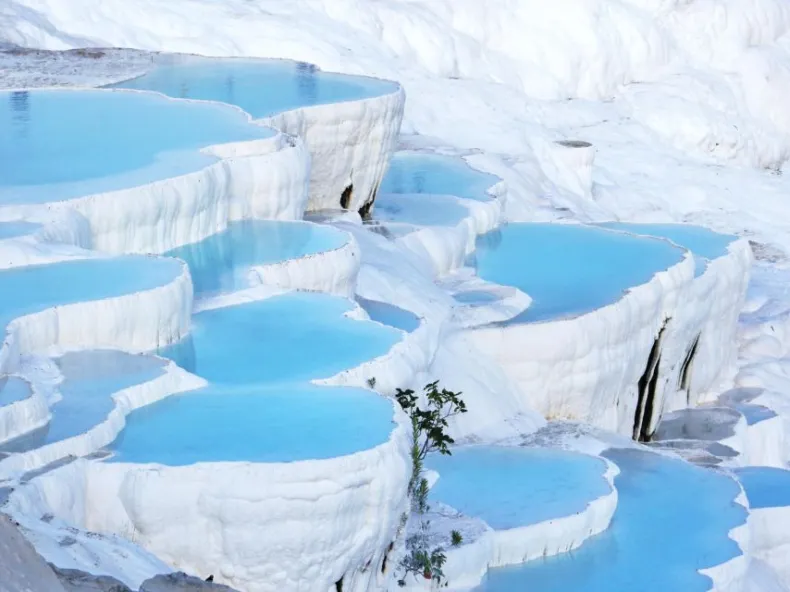
Here is the swap the day offers: green canyon walls at the start of your week, white calcite ones by its middle. Göynük's gorge funnels cold mountain water between shaded rock; Pamukkale reverses every setting — thermal warmth instead of snowmelt chill, a wide-open hillside instead of a narrow cleft, stone the colour of fresh plaster. You cross the designated section barefoot, by site rule rather than preference, reading ridges of calcite with your feet while shallow spring water pushes past your ankles. Wading is the whole sport here; proper swimming belongs to one place only, and it comes later. Above the terraces the day turns archaeological: Hierapolis, the Greco-Roman spa city built around these springs, unrolls its necropolis — among the best-preserved ancient burial grounds in Anatolia — its monumental gates and its theatre worked into the slope, all narrated by your licensed guide. UNESCO inscribed terraces and city together in 1988 as one mixed World Heritage Site; read our Hierapolis primer and the stones will say more.
Active travellers usually plan on real numbers, so here they are, fog-free. €50 per person, one flat rate from every Göynük hotel — beachfront block or guesthouse up towards the nature park, it makes no difference — for everybody aged 4 and up, with infants of 0–3 carried free. The rate buys the round trip by air-conditioned coach, a licensed guide, travel insurance and all three meals of the day: breakfast en route, lunch near the site, dinner rolling home. Every drink stays on your own tab, and the official entrance tickets are deliberately unbundled: those prices belong to the site administration and shift with the seasons, so you pay whatever the gate genuinely charges that season instead of a padded guess inside ours. Our ticket explainer covers it in two minutes' reading.
Reckon with roughly 12–13 hours door to door — about the energy budget of a long canyon day, except the coach does the climbing and three meals appear along the way. Some seasonal routings fold in Karahayıt, the village whose iron-rich springs run red, or Lake Salda and its pale mineral shore; count both as happy accidents rather than fixtures. The admin side stays light: reserve seats online without paying anything, hand over the €50 on tour day, and cancel free of charge up to 24 hours ahead if the forecast rearranges your week. Friends staying a village closer to Antalya? The same coach also calls at Beldibi on its morning sweep.
Pamukkale Tour from Göynük
FAQ
How long is the drive from Göynük to Pamukkale?+
Around 275 km each way. With the standard rest stops that means 3.5–4 hours of travel in each direction and roughly 12–13 hours for the whole outing, door to door. Breakfast comes during the outward leg and dinner during the return, which shortens the road considerably in practice.
We came to Göynük for the canyon — will Pamukkale feel tame by comparison?+
Different, not tame. The day is walked, not watched: a barefoot crossing of the travertine section, then Hierapolis spreading over a huge open hillside with its necropolis, monumental streets and a climb up to the Roman theatre. It trades the adrenaline of a gorge for scale and strangeness, and active guests rarely leave unimpressed.
Can we swim anywhere on the Pamukkale day?+
Not on the terraces — the open-section pools are shallow, and the rule there is barefoot wading, which is what protects the white calcite. The one genuine swim is the Cleopatra Antique Pool beside Hierapolis, where you float over submerged Roman columns; it is optional, and its separate ticket is bought at the pool itself.
How do booking and payment work from Göynük?+
Everything stays flexible: the reservation costs nothing and happens online, the €50 is paid in person on tour day, and cancellation stays free up to 24 hours before departure. The confirmation e-mail brings a printable ticket, and the pickup hour for your own hotel is confirmed with it rather than guessed from a timetable.