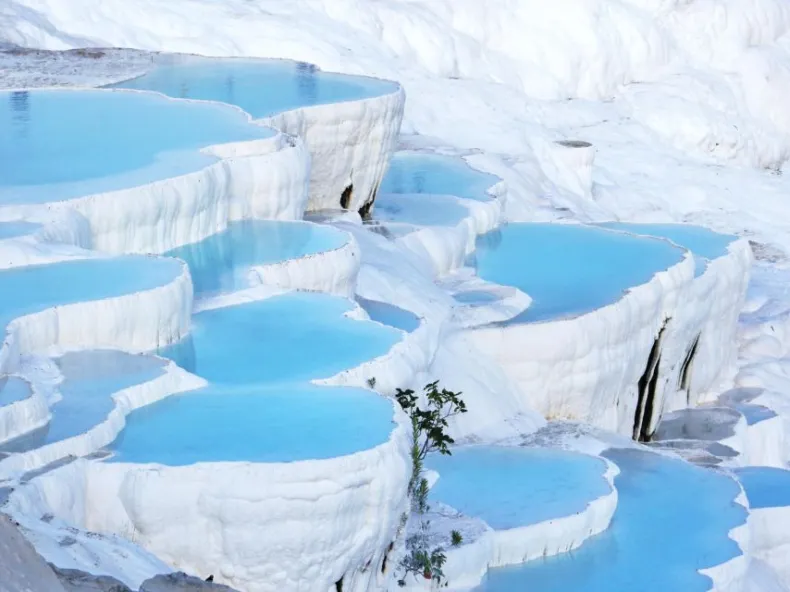
The single most useful thing to know about Pamukkale weather is that it is not your hotel's weather. The white terraces sit on an inland plateau in Denizli province, on the far side of the Taurus mountains from the Mediterranean — and inland plateaus play by different rules than a humid coastline. Summer runs hotter and drier through the middle of the day, winter runs distinctly cooler, and the seasons in between move faster and more theatrically than anything you will see from a sunlounger.
One holiday, two climates
Your beach resort lives under maritime weather: sea breezes, soft humid air, mild winters. The coach to Pamukkale climbs out of all that, crosses the mountains and drops you into a continental pocket where the air is drier and the daily swings are wider. Mornings and evenings feel noticeably cooler than the middle of the day, in every season.
This is why packing advice for Pamukkale sometimes sounds contradictory. It is not — it is simply advice for two climates at once. You leave the coast in soft early-morning air, spend midday under a plateau sky, and come home through mountain darkness with dinner served on the way. Dressing in removable layers is not a tip; it is the whole system.
A practical note on forecasts: if you look one up before the trip, look up Pamukkale or Denizli rather than your resort — the coastal forecast tells you about your beach, not your destination, and the two can disagree cheerfully on the same morning. Then hold whatever you read loosely. Plateau weather likes changing its mind across a long day, and the tour's structure — coach, meals, guided timings — is built to flex around it without you noticing. The visit happens under every kind of sky; only your packing changes. One more inland trait worth knowing: clear evenings cool quickly once the sun drops, which is why the light jacket stays in the bag even on a warm-looking day — the dinner stretch of the drive home is when you will reach for it.
The year in four honest movements
Summer is the season of intensity. The plateau bakes under a fixed blue sky, and the white calcite doubles the sunshine by bouncing it back up at you. It is entirely doable — and spectacular — with a hat, sunscreen and discipline about water; our summer heat playbook turns it into a routine rather than an ordeal.
Autumn is the season of balance. The light softens, the air relaxes, the crowds ease, and the warm thermal water starts to feel like a luxury as the plateau cools around it. If you want the fullest version of that case, the guide to Pamukkale in October and November makes it in detail.
Winter is the season of atmosphere. Cool, crisp plateau air meets water that emerges warm all year round, and the terraces steam. Days are shorter and layers are compulsory, but the reward is the site at its quietest and most mysterious — the full argument lives in the winter guide.
Spring is the season of movement. The land around the terraces turns green, skies build and break through the day, and walking weather is at its kindest. Photographers and families both tend to call it their favourite; the spring guide explains why.
What the weather means for your bag
The packing consequences are refreshingly simple. Sun protection is non-negotiable from spring through autumn: brimmed hat, sunglasses, high-SPF cream — the white surface reflects light from below, which catches out people who never burn at the beach. A refillable water bottle earns its place in every season, because plateau air is dry even when it is cool.
Layers do the rest. A light jacket covers spring and autumn's cool mornings; winter asks for a proper warm coat and something windproof. Comfortable closed shoes matter year-round for the ancient city, and a small towel is the most underrated item on the list — shoes come off on the terraces' open section, and dry feet make the walk back to the coach far more pleasant. Swimwear is needed only if you plan the optional Cleopatra Pool, which has its own ticket on site.
The parts no forecast can touch
Three things about the day are weatherproof. The thermal water is warm in every month — that is geology, not climate. The coach is air-conditioned in summer and heated in winter, and it waits through the day as your refuge. And the three included meals arrive on schedule whatever the sky does: breakfast on the morning drive, lunch near the site, dinner rolling home.
So the honest answer to "what will the weather be like?" is: different from the coast, changeable with the season, and far less decisive than people fear. The terraces have been performing in every kind of light for thousands of years. Check the season guides above, pack the layers, and reserve your seat online for free — you pay on the day, and cancellation is free up to 24 hours before departure if your plans shift. For choosing between the seasons themselves, our best time to visit guide puts all four side by side.